Articles in this Volume

Research Article Open Access
The Creation and Dissemination Dilemmas and Breakthrough Paths of Campus Vlogs by Ordinary College Students under Algorithmic Logic
Recently, people pay much attention to campus Vlogs made by college students. But most studies focus on commercial monetization and they ignore normal creators. In fact, they do not look at the problems these students have.In this work, we look at problems in creating and spreading campus Vlogs by ordinary college student's campus vlog, and we identify the types, development features, as well as dual effects. It is worth noting that these students face some practical problems, for example, creators has limited ability, a lack ofresourcesupport, and the content is similar. Therefore, we propose methods from three aspects: fitting algorithm rules, improving content quality, andwe combinecontent with external traffic attention, so that we can improve spreading efficiency for college creators. These methods can improve the dissemination efficiency and influence of college students' campus vlogs, and give practical guidance for young creators who want to keep their practice in the competitive digital environment.
Show more
Read Article PDF
Cite
Research Article Open Access
The Correlation Between Visual Complexity, Information Presentation and Game User Experience
With the growing market in the field of games and the accelerating polarization in game design towards little and a great deal, the theme of game UI design has become dual-sided and experienced two extremes, both of which are problematic, but in different ways: one causes harm to the player experience through over-visualization, and another through over-simplification. This paper identifies the joint impact of visual complexity and information presentation on three levels of game user experience based on a systematic literature review of a game UX body of research, game user interface design, and visual cognition research bodies, and augmented with case studies of Arknights and Deep Palace Melody. The results show that interfaces that are too complex lead to cognitive overload and thus hinder functional and hedonic experience whereas simplified interfaces lead to poor emotional investment and meaningful experience by not providing them with adequate visual expression. Both the information presentation and the visual style consistency make up a unified design system that regulates the experiential coherence. It is summed up that a successful game UI design is in a dynamic equilibrium between the visual richness and information visibility - and that this equilibrium depends on the type of game and the audience, and there is no single standard that can be universally applied. Game UI design can thus be identified as an essential layer within the development of full experiences of players.
Show more
Read Article PDF
Cite
Research Article Open Access
The Effects of Working Memory Capacity on the Use of Formulaic Language in L2 Speech Production
Working memory (WM) has been widely acknowledged as a significant cognitive mechanism responsible for multiple tasks including information storage and processing. L2 oral production, as a complex cognitive activity, has been found to be restricted by working memory capacity (WMC). However, the specific aspects of L2 oral speech affected by WMC remain controversial due to methodological variations, which suggests the need of a mediating factor to reveal the underlying cognitive dynamic. In order to fill this gap, the current study focuses on a potential mediating variable, the use of formulaic language, which requires the involvement of WM and also proves to be an effective tool to mitigate cognitive load during L2 oral production. By comparing the low and high WM groups' performances in L2 impromptu speech in terms of the use of formulaic sequences, the study has found that the high WM group showed an overall higher frequency of the use of formulaic language, with a significant advantage in the frequency and diversity of polywords over the low WM group. Moreover, the errors in the speeches could be classified into interlingual, intralingual, redundancy, and blending ones. By delving into the causes of each type of errors, the retrospective interviews revealed that a larger WMC supported more efficient multitasking, greater attentional and inhibitory control, and more complex online processing, which contributed to high-level L2 oral production. The results offer implications for improving L2 learners' oral competence and serve as a lens into the interaction between WM and L2 oral performance.
Show more
Read Article PDF
Cite
Research Article Open Access
Visualization as Dialogic Medium: Generative AI, Positional Repositioning, and the Apparatus of Architectural Representation
Article thumbnail
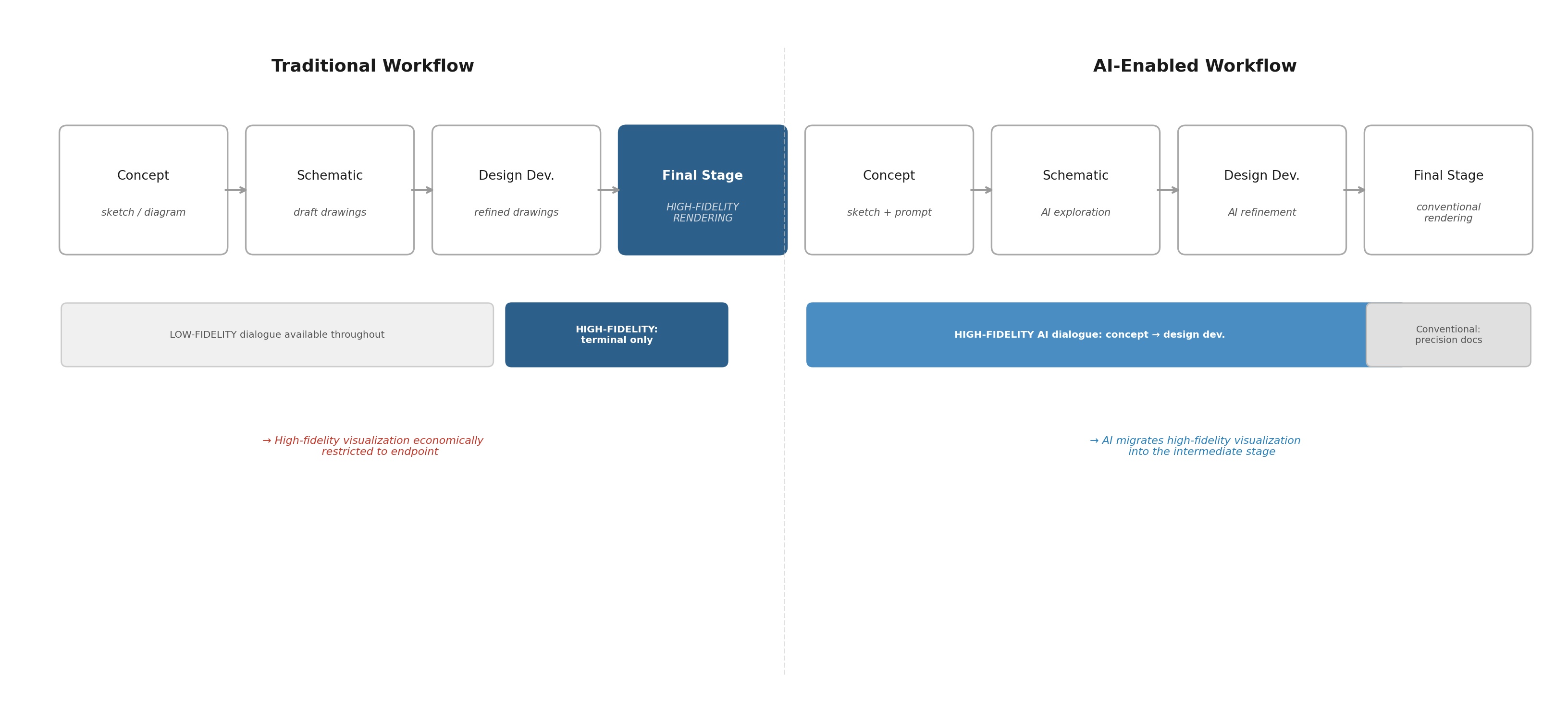
This paper is a theoretical and literature-based critical analysis examining how generative AI repositions architectural visualization within the design process. It argues that the positional repositioning of visualization, its migration from the terminal stage into the operative middle of the design process, amplifies rather than neutralizes the constitutive agency of the medium: by embedding a high-fidelity apparatus at the site of open-ended conceptual exploration, generative AI subjects the most creatively consequential phase of design to an aesthetic logic the designer did not author and cannot inspect. Drawing on Lawson and Schön’s reflection-in-action framework, the paper analyzes the prompt-generation-evaluation cycle as a new form of design conversation. Through Flusser’s apparatus theory and Irrgang’s extensions, it reveals a structural epistemic asymmetry: the architect controls input and output, but the model’s internal aesthetic logic, encoded in a latent space conditioned by historically biased training data, remains opaque. Del Campo’s analysis of the architectural latent space identifies this corpus as a site of inherited canonical bias. A design experiment testing a culturally specific vernacular façade vocabulary against generative model outputs demonstrates this asymmetry in practice. The paper concludes that AI visualization is simultaneously expansive and constraining, functioning as a medium with its own constitutive agency rather than a neutral accelerant.
Show more
Read Article PDF
Cite