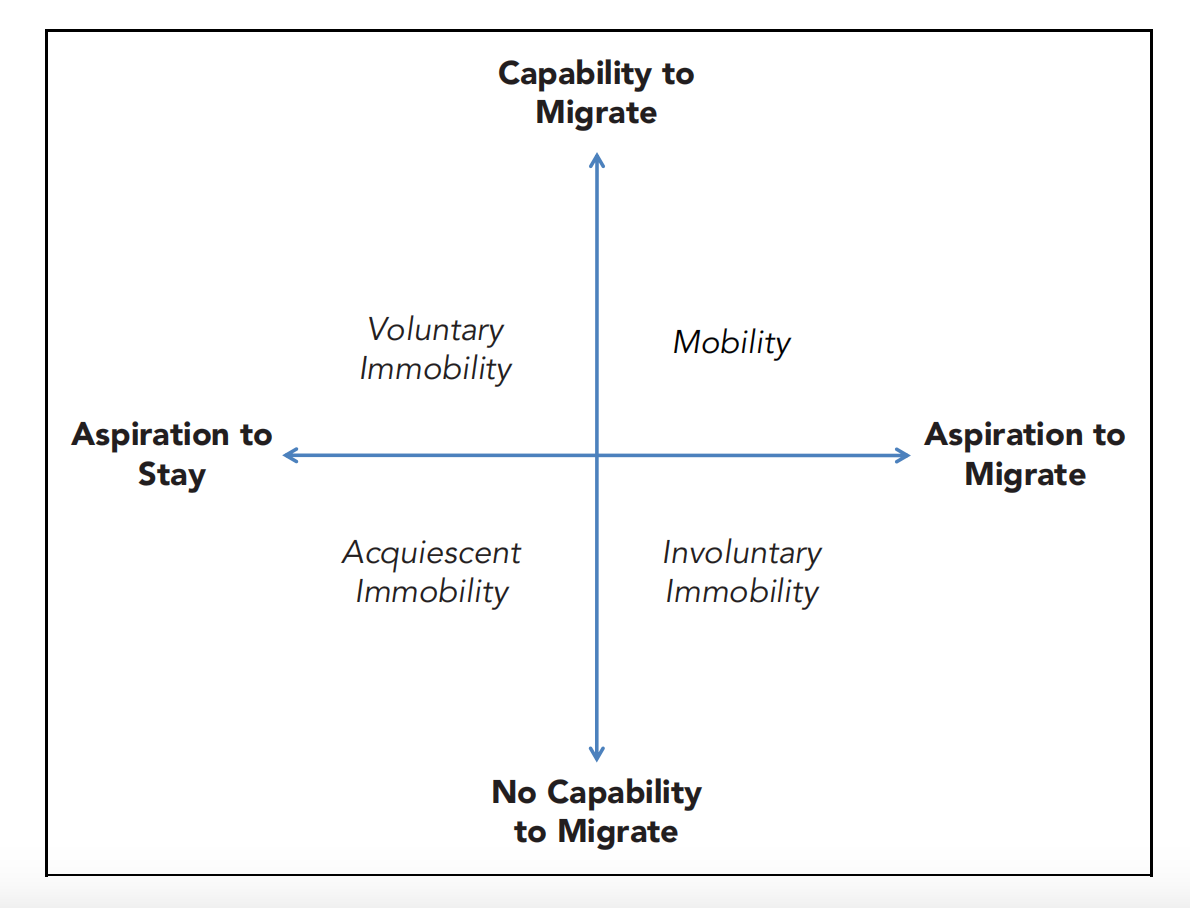
This paper proposes a revised, operational Aspiration-Capability Assessment Model based on Kerilyn Shewel's Aspiration-Capability Framework, with accompanying assessment questionnaires (measuring subjective aspiration and objective capability) to measure the (im)mobility of individuals or groups. The questionnaires provide numerical scores and plot respondents on a quadrant diagram (x-axis: aspiration; y-axis: capability). Each axis features five calibrated levels, with data points colored according to age. The research methodology focuses on model design and demonstration, followed by a synthesis of literature, comparative case studies across African contexts, and the construction of three composite roles derived from multiple empirical studies to explain the social/cultural, policy/political, and safety/security barriers to upward mobility faced by Chinese immigrants in Africa. The quadrant diagram positions and corresponding interpretations for each role are then presented. The purpose is not to conduct regional migration research but to demonstrate the model's portability and operability. This paper argues that the Aspiration-Capability Assessment Model provides researchers and policymakers with a lightweight, comparable diagnostic method, offering further developments in research on measuring individual (im)mobility.