


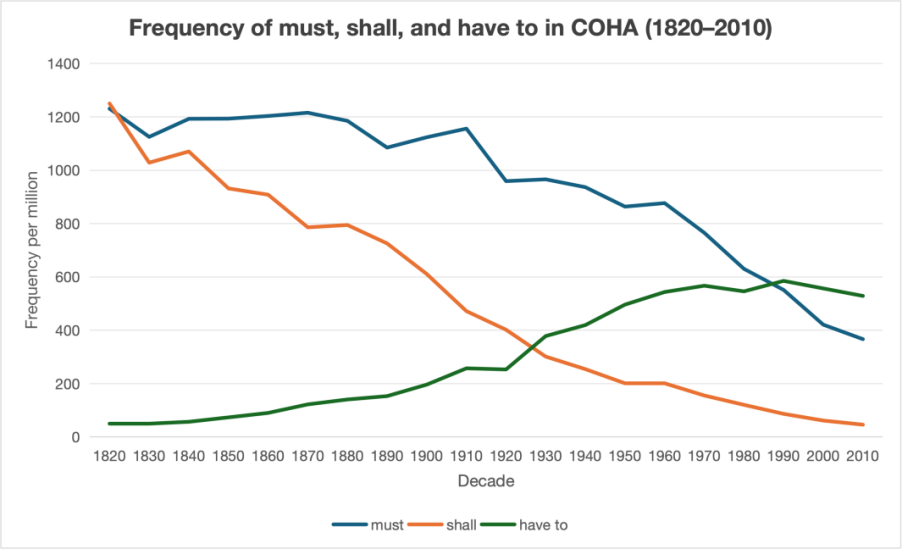
As English continues to change in both spoken and written communication, the use of modal expressions has also shifted. Core modal auxiliaries such as must and shall appear to be less dominant, while semi-modal constructions such as have to have become increasingly common. This study investigates the diachronic change and functional relationship among must, shall, and have to in American English. It aims to examine whether must and shall decline over time, whether have to rises, and whether have to can partially replace must in expressing obligation or necessity. Using COHA and COCA as the main data sources, this study combines frequency analysis, register comparison, Pearson correlation, and semantic coding of concordance lines. The results show that must and shall decline over time, while have to increases significantly, especially in spoken English. The study concludes that have to represents a partial functional replacement of deontic must and reflects broader processes of colloquialization and semi-modalization.