
Articles in this Volume

Research Article Open Access
The Application of Intelligent Technologies in the Creation of Historical Documentary Films
Article thumbnail
In the context of intelligent media, communication ushers in an unprecedented transformation. As an important way of cultural communication, documentary production is exploring the deep integration with emerging technologies. As an important part of documentary creation, historical documentary films are constantly integrated with intelligent technology in reality creation due to their special attributes. The research scope of this paper is under the national "new quality productivity" development strategy to explore the application and potential of intelligent technology in the content shaping of historical documentary films. It is mainly reflected in the selection of massive historical literature materials through artificial intelligence algorithms, the full integration of classified valuable information, and the provision of creative materials and basis for film creation; Post editing and special effect processing through intelligent technology to enhance the film's expressiveness; Restore historical moments and shape spatial scenes through intelligent technologies such as AR, VR virtualization and face recognition; Accurate calculation between works and audiences is achieved through data analysis, and communication channels are expanded. The coupling development of intelligent technology and historical documentary creation promotes its content innovation, stimulates its creative potential, and realizes the digitalization and intelligent content shaping of historical documentary. Through this article, I hope to provide new ideas for the intelligent development of historical documentary creation.
Show more
Read Article PDF
Cite
Research Article Open Access
A Cultural Publishing Perspective on the Development of Artificial Intelligence in the Process of Impacts and Opportunities
In the wave of informatization and digitization, generative artificial intelligence (AIGC), an important branch of artificial intelligence technology, is gradually penetrating and reshaping the publishing industry. Through systematic analysis and research, this paper discusses the current status of the application, its development path, and the challenges generative AI faces in the publishing industry. Firstly, this paper explains the basic principles of generative AI technology and its advantages in content generation. It also analyses its specific application scenarios in various content forms such as text, image, audio, and video. Secondly, this paper discusses the various paths of generative AI to enable the high-quality development of the publishing industry, including improving content production efficiency, promoting creative diversity of content, and optimizing the publishing process. At the same time, this paper also analyses the technical bottlenecks, market barriers, and ethical and safety issues faced by the application of generative AI in the publishing industry, and puts forward some strategies and suggestions to cope with these challenges.
Show more
Read Article PDF
Cite
Research Article Open Access
Visible Artificial Intelligence: Exploring the Enhancement of Chatgpt and Film Script Creation
As a joint link of artificial intelligence products, the emergence of ChatGPT triggered a global debate, and attracted the attention of practitioners all over the world. Meanwhile, multiple film and television production fields such as computer graphics processing, digital virtual shooting, CG special effects production, have embedded automatic content generation factors. However, artificial intelligence is also facing legal dilemmas and ethical constraints, researchers need to compare and analyze its advantages and problems, systematically consider the strengths and impacts, limitations and problems of AIGC, and provide reference and practical guidance for AI to better promote itself.
Show more
Read Article PDF
Cite
Research Article Open Access
The Logical Path of Applying Sora Technology in the Cultural Industry
Today, with the in-depth development of science and technology, the application of artificial intelligence has become a new driving force for the development of the cultural industry. As the latest technological achievement in the field of generative artificial intelligence, the rational application of Sora in the cultural industry can produce synergistic effects and significant results. This paper aims to sort out the application logic of Sora technology in the cultural industry, comprehensively showcasing its core features of technology-driven, multi-faceted synergy, and paradigm shift from the five elements of technology, information, talent, systems, and channels. In this process, in order to further optimize the application of Sora technology in the cultural industry, it is necessary to strengthen the construction through innovative strategies, and improve the technological, economic, and aesthetic dimensions, thereby contributing to the prosperity and flourishing of socialist culture with Chinese characteristics.
Show more
Read Article PDF
Cite
Research Article Open Access
Changes and Mechanisms of Social Interaction Models in the Digital Age
In the wave of the digital age, technology is rapidly evolving from Web 1.0 to Web 2.0 and moving towards the new era of the metaverse. Social media, as a pioneer of this transformation, has deeply permeated people’s daily lives, reshaping our social interaction models. The rise of "companion socialization" is a typical phenomenon in this transformation, reflecting significant changes in social interaction models in the digital age. This paper aims to systematically review the notable changes in social speed, social subjects, and social methods during the evolution of social media, and to deeply analyze the reasons behind these changes. By exploring the mechanisms of market evolution, platform manipulation, and user addiction, this study seeks to help people better understand the pros and cons of social media, adopt a more rational attitude towards the social challenges of the digital age, and promote the construction of a healthy social ecosystem.
Show more
Read Article PDF
Cite
Research Article Open Access
Despair and Hope in Nonsense: A Study of the Subcultural Ritual of Youth —Taking "Crazy Literature" as an Example
In the era of intelligent communication, the phenomenon of folk discourse production in online society is increasingly common. From the initial roaring style to the prevalent “crazy literature” today, various so-called internet “literature” emerges endlessly, becoming a “media spectacle” and also giving various forms of expression to the subculture of despair. Although “crazy literature” belongs to the category of the subcultural ritual of despair, those who are “despairing” are “not despairing”. Young people release emotions in despair through hysterical nonsense, and seek hope by establishing emotional connections with others in the same circle. This paper analyzes “crazy literature” from the perspective of interactive ritual chains, explores the formation mechanism of discourse carnival, and reveals the cultural symptoms behind “crazy literature”, providing a pathway for understanding “crazy literature” and the culture of despair.
Show more
Read Article PDF
Cite
Research Article Open Access
The Prevalence of Self-Exploitation in Media Production: Analyzing the Impact of Technological and Societal Transformations
The development of science and technology and the changes of society have given a new look to traditional conceptual work. The developed network and ubiquitous communication have broken the time and space boundaries of work. Working from home has become a reality. Some people continue to predict that work will become a relaxed enjoyment. But the reality is frustrating. Not only did people not relax, but they also took on increasingly heavy work pressures. The boundaries between work and leisure are eliminated by heavy business, and the office is transformed into a place where people spend the most time. Therefore, work is no longer a pleasure, but self-exploitation behaviour. The unstable and unsafe nature of creative work in the media industry creates stress and anxiety, and the strong emotional pleasure associated with this kind of work exists. The tension between "pleasure" and "pain" in creative occupations has been fully proven. Unstable labour has now become a key feature of creative work. Creative occupations are driven by self-fulfilling desires and are places for exploitation and serious insecurity.
Show more
Read Article PDF
Cite
Research Article Open Access
Erosion and Remodeling: New Alienation of User Subjects Led by Intelligent Algorithms
Article thumbnail
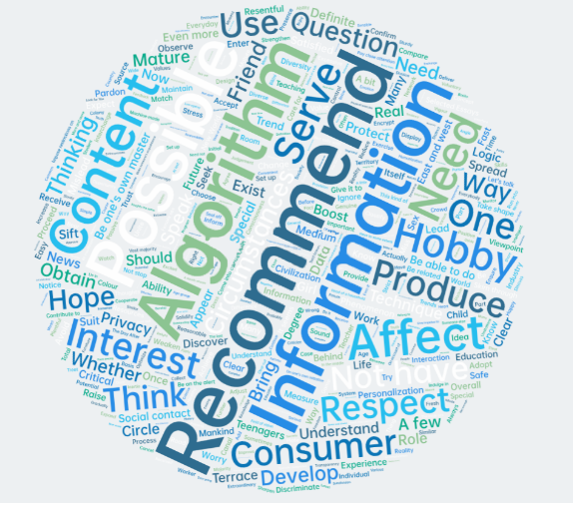
As the core technological means of today's artificial intelligence products, intelligent algorithms have become an indispensable tool for human development. They have led the progress of the intelligent era, fully demonstrating the powerful charm and infinite possibilities of technology, and depicting a hopeful intelligent future. However, while bringing convenience and imagination to users, it also makes them objects dominated by intelligent technology, gradually losing their independence and creativity as humans, losing their ability to criticize and think deeply, and causing a series of inevitable alienation problems that cannot be ignored. This article uses qualitative research methods to conduct in-depth interviews with respondents, extract their attitudes and opinions towards one of the artificial intelligence technologies - algorithms, and organize and analyze them. The phenomenon of "new alienation" brought about by reshaping algorithms is based on users' real thinking and more accurate needs, breaking the constraints of intelligence and adding benefits to the development of algorithms.
Show more
Read Article PDF
Cite
Research Article Open Access
Human-machine Voice and Human-machine Competition: Practical Landscape, Pattern Changes and Industrial Challenges of Generative AI-Enabled Audiobook Publishing
At present, generative artificial intelligence has a profound impact on the audiobook publishing industry chain, and exerts unprecedented transformative power in all aspects of audiobook publishing. This paper reviews the specific technical forms of generative artificial intelligence used in the process of audiobook publishing, including text-to-speech, speech recognition, intelligent speech interaction, voiceprint recognition, voice anonymization, etc., and shows the practical picture of how these technologies influence audiobook publishing in different stages of content creation, sound presentation, recording and editing, quality control, terminal playback and readers’ feedback. It analyzes the pattern changes of the audiobook publishing industry brought about by generative artificial intelligence, with "human-machine voice" as the core, and then discusses the challenges and reflections faced by the audiobook publishing industry under the trend of "human-machine competition and cooperation" from the aspects of underlying logic, industry pain points, fundamental principle, reading environment and technical ethics. Therefore, generative artificial intelligence technology is like a double-edged sword, audiobook publishers should fully understand its nature, conform to the trend of technology, and use it to enable new quality productive forces of audiobook publishing industry.
Show more
Read Article PDF
Cite
Research Article Open Access
A New Demon after Collapse: Jewish Social Media Images in the Israeli Palestinian Conflict—Short Videos' Analysis Based on TikTok
From over two thousand years of exile history to post World War II Holocaust literature and film and television dramas, Jews have always appeared in various media as innocent victims with a mix of sadness and resilience, even making the "Jewish stance" somewhat politically correct. This article is based on the new round of Palestinian Israeli conflict that broke out on October 7, 2023. The research object is 729 short video data crawled on social media TikTok. Through analyzing the overall attitudes towards Jews presented in the videos, it is found that the ratio of positive and negative attitudes is about 1:12, and "genocide", "war criminals", and "terrorism" are the majority of accusations against Israeli Jews in the videos. The large number of negative evaluations on social media presented in the research conclusion strongly contrasts with the stereotypical impression of Jews in past media expressions. This finding is crucial for China's future diplomatic practice and how to enhance its ability to guide international public opinion.
Show more
Read Article PDF
Cite