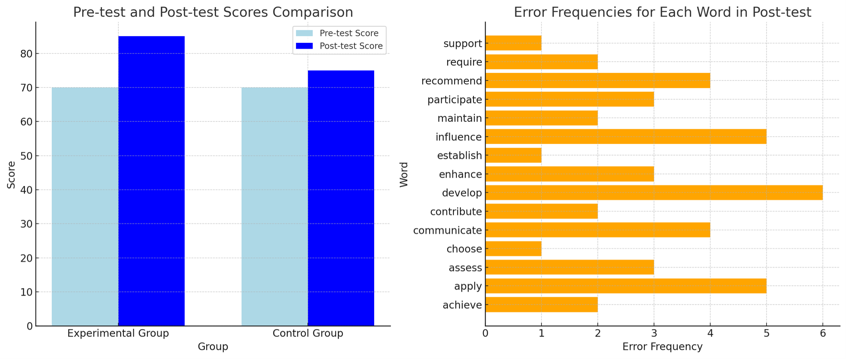
This study investigates the effectiveness of AI tools as instructional supports for grammar in enhancing second language learners’ accuracy in using non-finite verb forms. The study sample comprised 60 sophomore English as a Foreign Language (EFL) students, divided into an experimental group and a control group. The experimental group received instruction via AI tools, including ChatGPT, while the control group was taught through traditional methods. Instructional content encompassed 15 primary non-finite verbs, such as infinitives, gerunds, and participles, designed to help learners flexibly apply these forms in diverse contexts. Conducted over six weeks, the study allocated the initial two weeks to introducing the foundational concepts and forms of non-finite verbs, supplemented with introductory exercises via AI tools. During the following three weeks, learners examined advanced applications, reinforced through personalized exercises provided by the AI tools, supporting accurate usage in complex sentence structures. The final week focused on review and consolidation. Pre- and post-tests measured learners’ grammatical accuracy, revealing that the experimental group showed significantly greater improvement than the control group, suggesting a clear benefit of AI tools for grammatical precision and retention. These tools offer a tailored learning experience adaptable to learners’ specific needs, fostering increased learner confidence and autonomy. This study provides a potential instructional framework for educators and empirical support for AI integration in language teaching, contributing meaningful theoretical and practical insights.